TYPE: Mortuary God
ORIGIN: Egyptian
KNOWN PERIOD OF WORSHIP: Circa 2700 BCE (but extended from pre-Dynastic times) until end of Egyptian history circa 400 CE
SYNONYMS: Imy-ut (he who is in the mortuary); Khenty-imentiu (chief of the westerners); Khenty-seh-netjer (Chief of the Gods' pavilion); Neb-ta-d-jeser (lord of the sacred land); Tepy-dju-ef (he who is upon the mountain).
CENTER(S) OF CULT: the necropolis at Memphis and elsewhere
ART REFERENCES: Tomb effigies, wall paintings, statuettes, etc.
LITERARY SOURCES: Pyramid Texts, funerary texts and hymns
MAJOR CULT CENTER: Lycopolis, Cynopolis
SYMBOL: mummy gauze, fetish, jackal, flail
PARENTS: Nephthys and Set, Osiris (Middle and New Kingdom), or Ra (Old Kingdom)
SIBLINGS: Wepwawet
CONSORT: Anput, Nephthys
OFFSPRING: Kebechet
GREEK EQUIVALENT: Hades or Hermes
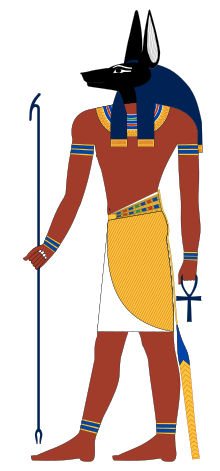
INFORMATION: The parentage of Anubis is confused but the most popular notion seems to place him as a son of Re and of Nephthys or Isis. The god of mortuaries, Anubis takes the form of a black dog or jackal usually in a lying down or crouching position, ears pricked and long tail hanging. He wears a collar with magical connotations. Less often he appears in human form with a canine head. The imagery of a dog probably originated from observation of bodies being scavenged from shallow graves and the desire to protect them from such a fate by manifesting Anubis as a dog himself. The Book of the Dead has him standing by the scales in which the heart is weighed in the Hall of the Two truths, and he is sometimes known as the "Claimer of Hearts". Anubis was perceived to superintend the embalming of kings and courtiers in the mortuary and the subsequent binding with linen bandages. His coat color is thought to be black because of the color of the corpse after the embalming process, which darkened it, and the use of black tar to seal the binding. His symbol in the context of mortuary god is an animal skin, headless, dripping blood and tied to a pole. At the subsequent funeral ceremony of the Opening of the Mouth the priest wore a jackal headdress. The main cemetery sites are on the west bank of the Nile where the sun sets, hence one epithet for Anubis—"Chief of the Westernsy"; another, "he who is upon the mountain", conjures an image of Anubis watching over the cemeteries from the high escarpments.
In the Greco-Roman period he became a cosmic deity of earth and sky somewhat removed from his older function.